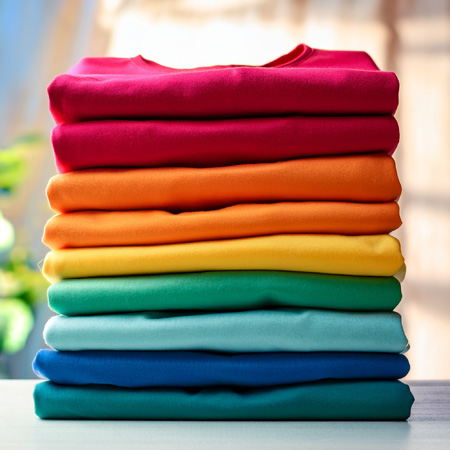



Runway with slogan

Fashion made possible by global trade

Fashion made possible by global trade

Fashion made possible by global trade

FTC

  • Legis 1: Jockey International Hires Checkmate on Trade Policy

    On a 7 May deadline, Legis 1 reports on new Jockey International entering the federal lobbying arena. 

    Legis 1 Editorial | May 7, 2026

    The following is an excerpt....


    Jockey's sourcing footprint sits squarely in the countries most affected by the Trump administration's tariff actions. Reuters reported in April 2025 that Bangladesh faces a 35 percent U.S. tariff, raising an alarm across the garment industry. The Business and Human Rights Centre noted that if those duties take effect, U.S. buyers could shift orders significantly.

    The financial stakes for comparable companies are substantial. Research from FASH455 documented one underwear brand facing a gross tariff impact of approximately $120 million, with a net fiscal year impact of roughly $50 million after mitigation. The same research noted that men's underwear saw some of the highest retail price increases in September 2025 and February 2026 compared to the prior year periods.

    The United States Fashion Industry Association estimated that if 2025 import values hold steady, reciprocal tariffs would generate nearly $35 billion in total duties on textile and apparel products, an increase of $19.9 billion over prior levels.


    Read the full article here

  • The National Law Review: Navigating the FTC Care Labeling Rule in the Modern Age

    On a 1 May deadline, the National Law Review reports on new the rules of FTC Care Labeling. 

    Kristin McGaver Sikora, Megan Chester, Foley & Lardner LLP | May 1, 2026

    The following is an excerpt....


    Comment from U.S. Fashion Industry Association, Docket FTC-2025-0024-0001 (Apr. 18, 2025) (“USFIA is in full agreement with the regulatory language proposed by AAFA. We emphasize that textiles and apparel is a global business. USFIA members market their products throughout the world. Different markets have different labeling requirements and different language requirements. This has led to ever larger and more complicated care labels. These extensive labels are wasteful and uncomfortable for consumers. Digital labels would effectively reduce trade barriers for global companies. Digital labeling would allow firms to provide detailed product information for multiple countries in a readily accessible manner, such as using a simple QR code or other digital tools, resulting in reduced labels and label size. This approach also would enable firms to provide updated information to consumers, something which is not realistically available under the current system. Finally, it is sometimes the case that over time labels become illegible. The likelihood of that happening with a digital label is diminished. Allowing the use of digital labels would establish a more harmonized approach to labeling as other countries, such as the EU, Singapore and Australia, have proposed or enacted digital labels.”).


    Read the full article here

  • USFIA Files Comments in Favor of Digital Labeling Petition

    Last week, USFIA filed comments with the Federal Trade Commission (FTC) in support of AAFA’s petition to allow digital care labels and the proposed regulatory language suggested. Our comments highlight that this is a global industry with different labeling requirements for different markets.

    Digital labeling would allow firms to provide detailed product information for multiple countries in a readily accessible manner, such as using a simple QR code or other digital tools, resulting in reduced labels and label size. This approach also would enable firms to provide updated information to consumers, something which is not realistically available under the current system.

    Finally, it is sometimes the case that over time labels become illegible. The likelihood of that happening with a digital label is diminished. Allowing the use of digital labels would establish a more harmonized approach to labeling as other countries, such as the EU, Singapore and Australia, have proposed or enacted digital labels.

    Most of the comments filed were in support of AAFA’s petition, including those from USFIA members Ralph Lauren and Taiwan Textile Federation, as well as the U.S. Chamber of Commerce, the PoliticallyInFashion Council, the National Cotton Council of America, and several apparel brands.

About

The United States Fashion Industry Association (USFIA) is dedicated to fashion made possible by global trade.

USFIA represents brands, retailers, importers, and wholesalers based in the United States and doing business globally. Founded in 1989, USFIA works to eliminate tariff and non-tariff barriers that impede the fashion industry’s ability to trade freely and create jobs in the United States.

Headquartered in Washington, DC, USFIA is the voice of the fashion industry in front of the U.S. government as well as international governments and stakeholders.  With constant, two-way communication, USFIA staff and counsel serve as the eyes and ears of our members in Washington and around the world, enabling them to stay ahead of the regulatory challenges of today and tomorrow. Through our publications, educational events, and networking opportunities, USFIA also connects with key stakeholders across the value chain including U.S. and international service providers, suppliers, and industry groups.


News

The State of Tariffs

President Trump has made sweeping changes to U.S. tariffs since he began his second term in January 2025. From the Liberation Day tariffs to the various Section 122 and 301 investigations and tariffs, U.S. trade has shifted more in the past year than almost anytime in history. USFIA is pleased to provide the following resources to those wanting to learn more about the state of tariffs in 2026.

fas fa-chart-line
10
Current baseline tariff on all trading partners

Imposed under Section 122, these temporary tariffs are set to expire on July 24, 2026.

fas fa-earth-americas
60
Countries threatened with Section 301 forced labor tariffs

A new 10% or 12.5% tariff on 60 U.S. trading partners under USTR's Section 301 forced labor investigation.

fas fa-money-bill-trend-up
121.7
in potential and certified refunds accepted in CAPE

CBP has accepted over a hundred billion in potentials and certified refunds since opening CAPE as of July 10, 2026.

Events

Reports

2026 USFIA Fashion Industry Benchmarking Study

The 2026 USFIA Fashion Industry Benchmarking study is now available to the public! Key findings from the report include:

  • The top business challenges facing U.S. fashion companies continue to center on the Trump Administration’s tariff policies, though concerns over inflation and increasing costs have also risen since 2025. 
  • 92% of respondents rated “Protectionist U.S. trade policies and related policy uncertainty, including the impact of the Trump tariffs” as one of their top two business challenges in 2026.
  • Among business concerns, managing forced-labor risks emerged as a significantly higher priority, rising from tenth place in 2025 to sixth place in 2026 and illustrating the industry's commitment to eradicating forced labor from their supply chains.
  • The job market is a bright spot. About 87% of companies plan to increase hiring over the next five years, up from last year and tying the highest level since the pandemic. Demand is expected to be strongest for data scientists, trade compliance specialists, and environmental sustainability specialists
  • AI is becoming increasingly integrated into apparel sourcing and business operations. 56% utilize AI for "demand forecasting and inventory planning," while 50% use it for "sustainability tracking," "risk management" and “sourcing strategy and cost optimization.”

Download the 2026 study here.

If you're interested in sharing your company's perspective for our 2027 study, fill out the interest form.

 Benchmarking 2026 top business challenges


Higher tariffs continue to trigger ripple effects across supply chains.

Figure 1-3 U.S. fashion companies reported deepened economic impacts of tariff hikes and policy uncertainties on their sourcing and business operations

Figure 1-4 U.S. fashion companies explored various methods to mitigate the evolving impacts of tariff hikes and policy uncertainties


Trends to watch: 

AI use could become increasingly prevalent in apparel sourcing as companies seek new technologies to improve operational efficiency and navigate a more complex, uncertain sourcing environment.Figure 2-24 AI is increasingly integrated into apparel sourcing and business operations


2026 Sourcing Trends & Outlook

USFIA's 2026 Sourcing Trends & Outlook is out with data from the full year of 2025. Members can log-in to the website to download it here

This is the thirteenth USFIA Sourcing Trends & Outlook Report, our annual look at the sourcing landscape for the fashion industry. 2025 will be remembered as the year of the Trump tariffs. U.S. imports fell as brands and retailers had to navigate a new level of uncertainty for sourcing and for costs. The reciprocal tariffs affected all countries, except for USMCA-qualifying production from Canada and Mexico.

As we look ahead to 2026, there still is a lot of uncertainty. The reciprocal tariffs were struck down by the Supreme Court, but the Trump Administration still is committed to impose tariffs above the MFN rates. The global tariffs imposed under Section 122 expire on July 24th and Administration officials say they will use other trade laws such as Section 301 and Section 232 to authorize more tariffs.

Even with the tariff disruptions, some of the major sourcing trends remain the same as in recent years. Asian suppliers continue to dominate apparel sourcing. The top seven apparel suppliers are China, Vietnam, Bangladesh, Cambodia, India, Indonesia, and Pakistan, and they ship 78% of apparel imports.

The top 5 sourcing trends in the report are:

  1. Asian apparel suppliers continue to dominate sourcing.
  2. China maintains its role as the top apparel supplier by quantity, and Vietnam is the top supplier by value.
  3. Average unit values for textiles and apparel imports had only modest increases.
  4. Some of the fastest growth in 2025 comes from major apparel suppliers.
  5. Despite tariff disruptions, FTAs and preference programs remain underutilized. CAFTA remains the major duty-free supplier.


While U.S. apparel imports decreased from many suppliers, there still are some clear winners from the tariff disruptions. Five of the top ten suppliers had double digit increases. Some of the fastest-growing suppliers are Asian-based apparel industries that took market share from China.

sourcing2026 fastest growing apparel suppliers


sourcing2026 applied tariff rates

Chart courtesy of Dr. Sheng Lu, Professor in the Department of Fashion and Apparel Studies, University of Delaware.

Partners

Subscribe to USFIA's Mailing List