Dr. Sheng Lu, Professor in the University of Delaware’s Department of Fashion and Apparel Studies, published a new study in Just Style, looking at India’s potential to play a more significant role as an apparel supplier. We reprint it in full below:
Will India become a key fashion sourcing major for US companies?
India has great potential to play a more significant role as a leading apparel supplier for US fashion companies. University of Delaware's Gabriella Giolli and Dr Sheng Lu investigate its advantages as well as any issues that still need to be addressed.
According to the 2024 Fashion Industry Benchmarking Study released by the US Fashion Industry Association (USFIA) in the summer of 2024, India surpassed Bangladesh to become the third most utilised apparel sourcing base, after China and Vietnam, among leading US fashion companies.
Nearly 60% of respondents planned to expand apparel sourcing from India over the next two years, exceeding the interest in other Asian or Western Hemisphere countries. Aligned with the survey results, in the first nine months of 2024, US apparel imports from India increased by 9.6% in quantity, much higher than 2.6% of the world average.
Despite India’s surge in popularity, the country remains less visible than other top-tier Asian apparel suppliers such as China, Vietnam, and Bangladesh. Many US fashion companies are unclear about India’s competitiveness as an apparel sourcing base, including the types of products it can produce, its sources of textile raw materials, and export growth potential.
By leveraging industry-level and product-level data, this study aims to explore the latest trends in US apparel sourcing from India and identify important emerging trade patterns to watch. The findings will provide valuable input for fashion companies and other stakeholders interested in understanding the opportunities and challenges associated with sourcing from the country in the context of the shifting sourcing business environment.
India’s textiles and apparel production
While India is known for making IT products, textiles and apparel are valuable contributors to India’s economy, accounting for about 2.3% of the country’s Gross Domestic Product (GDP) and 8% of total manufacturing value added in 2022, according to the World Bank. India is also one of the few countries with a dedicated Ministry of Textiles, which develops national policies to promote its textile and apparel sector, from production, exports, and domestic market growth to worker protection.
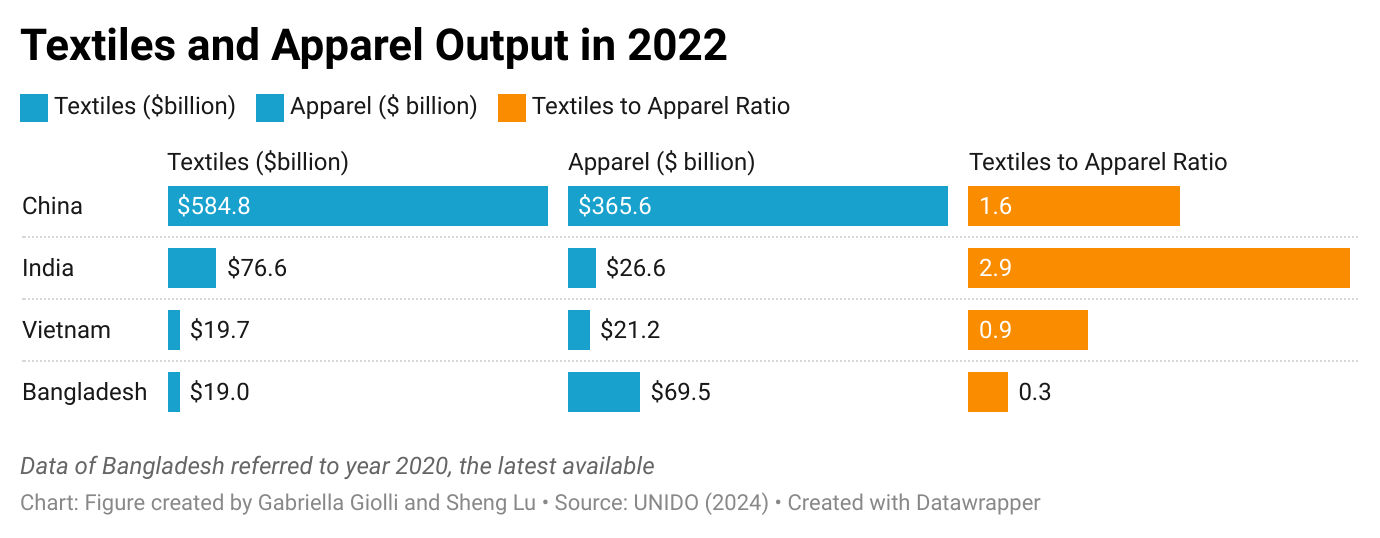
Data from the United Nations Industrial Development Organization (UNIDO) shows that India produced around $76.5bn in textiles and $26.64bn in wearing apparel in 2022. Although still smaller than China’s, this production scale has already surpassed that of most other Asian countries, including Vietnam. Behind these numbers were India’s over 4,000 ginning factories, 3,500 textile mills, and around 45m workers directly employed by the textile and apparel sector.
Additionally, India is one of the world’s largest textile fibre producers, including regular cotton, organic cotton, silk, polyester, and viscose. India also has more advanced local textile manufacturing capabilities than most other developing apparel-exporting Asian countries, allowing it to benefit from a vertically integrated local textile and apparel supply chain. For example, India’s textile-to-apparel production ratio reached 2.9 in 2022, more balanced than 0.9 in Vietnam and 0.3 in Bangladesh. Likewise, a recent US International Trade Commission (USITC) study noted that more than 90% of India’s textile raw materials needed for its apparel production can be sourced domestically. In comparison, as the World Trade Organization (WTO) global value chain analysis estimated, more than 64% of Vietnam’s apparel exports in 2022 contained foreign-made content (ie imported yarns and fabrics), 57% for Cambodia, 49% for Indonesia, and 33% for Bangladesh.
India’s apparel export market
India remained a much smaller apparel exporter than China, Vietnam, and Bangladesh. According to the World Trade Organization (WTO), India exported about $15bn in apparel in 2023, ranked the world’s sixth largest or 2.8% of the global total. Similarly, in 2023 India accounted for 5.5% of US apparel imports and 3.5% of the EU, showing its position as a significant supplier but not among the largest. However, unlike most other developing Asian countries, India exports less than half of its apparel output due to its massive domestic market with a population of 1.43bn. This implies that India’s substantial untapped apparel export potential should not be ignored.
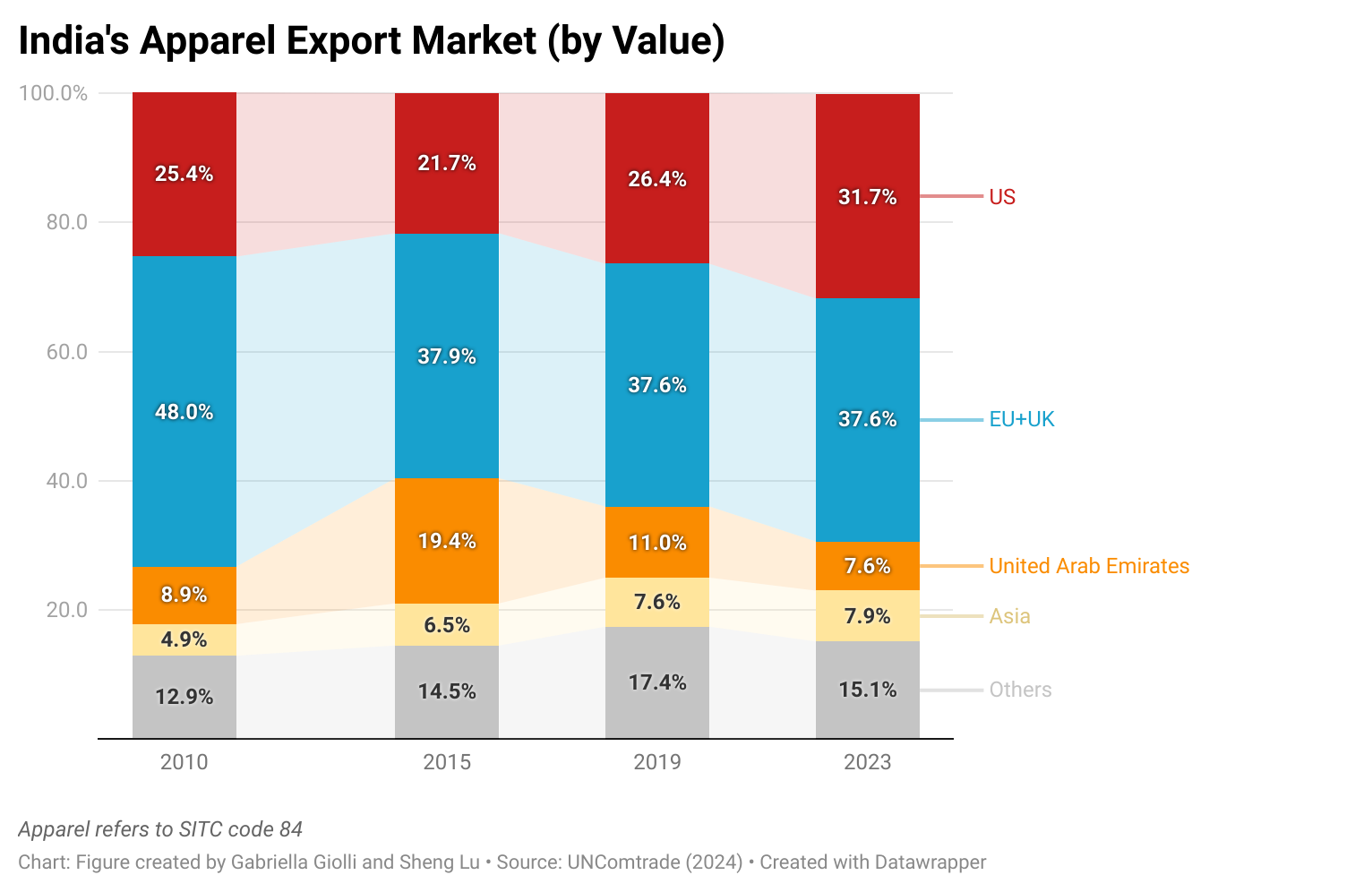
Like many Asian countries, nearly 70% of India’s apparel exports went to Europe (including the European Union members and the UK) and the United States, its two largest export markets.
The United States, in particular, accounted for 31% of India’s apparel exports in 2023, a historical high, thanks to the improved US-India bilateral relations and a growing interest among US fashion companies viewing India as an emerging sourcing destination. Indian apparel products also enjoy preferential duty benefits in the EU markets under the Generalized System of Preferences (GSP) programme and the UK’s Developing Countries Trading Scheme (DCTS).
Additionally, the United Arab Emirates (UAE) has been another critical apparel export market for India, accounting for 7.6-12% of the country’s total apparel exports over the past five years. The UAE-India Comprehensive Economic Partnership Agreement, which entered into force on 1 May 2022, further strengthened the bilateral trade ties and provided preferential duty benefits to India’s apparel exports to the UAE. However, given India’s relatively large apparel production capacity, US fashion companies have not faced concerns about competing with EU and UAE importers for sourcing orders in India.
Why is the US sourcing fashion from India?
The annual USFIA Benchmarking Study, together with the product-level data, provided unique insights into why US fashion companies source from India and the country’s evolving export competitiveness.
Firstly, aligned with trade statistics, many US fashion companies already source from India, although in a relatively small volume. For example, the USFIA survey respondents consistently ranked India as the third or fourth most utilised apparel sourcing base from 2021 to 2024, after China and Vietnam. However, US fashion companies typically place less than 10% of their total sourcing value or volume in India. The recent USITC study also raised concerns that India’s apparel factories were primarily small and medium-sized, which could limit their ability to fulfil large-volume sourcing orders.
Secondly, “Made in India” clothing is not necessarily cheap but could be perceived as “worth the value.” From 2021 to 2024, USFIA survey respondents consistently rated India on par with many other Asian apparel suppliers regarding its sourcing costs. Although India’s wage level was higher, its higher efficiency through an integrated local textile and apparel supply chain helped offset this cost disadvantage.
Notably, from January to October 2024, clothing labelled “Made in India” sold in the US retail market was on average priced much higher than imports from Bangladesh and Vietnam, particularly in the mass market segment. Meanwhile, in the premium market segment, clothing “Made in India” was on average priced relatively lower than “Made in China,” such as dresses, tops, and bottoms. These results suggest that US fashion companies do not typically consider India a preferred sourcing base for basic and price-sensitive items. Instead, India may be seen as a more cost-effective alternative to China for high-quality, value-added clothing.
Thirdly, India has been strengthening its competitiveness in export flexibility and agility, enabling its vendors to quickly adjust the delivery, volume, and product of the sourcing order upon customers’ requests. In the latest 2024 USFIA survey, respondents rated India’s sourcing flexibility and agility second only to China, surpassing Bangladesh, Cambodia, and Central American countries. Likewise, India was regarded as one of the few Asian countries that could fulfill apparel sourcing orders with relatively low “minimum order quantity (MOQ)” requirements.
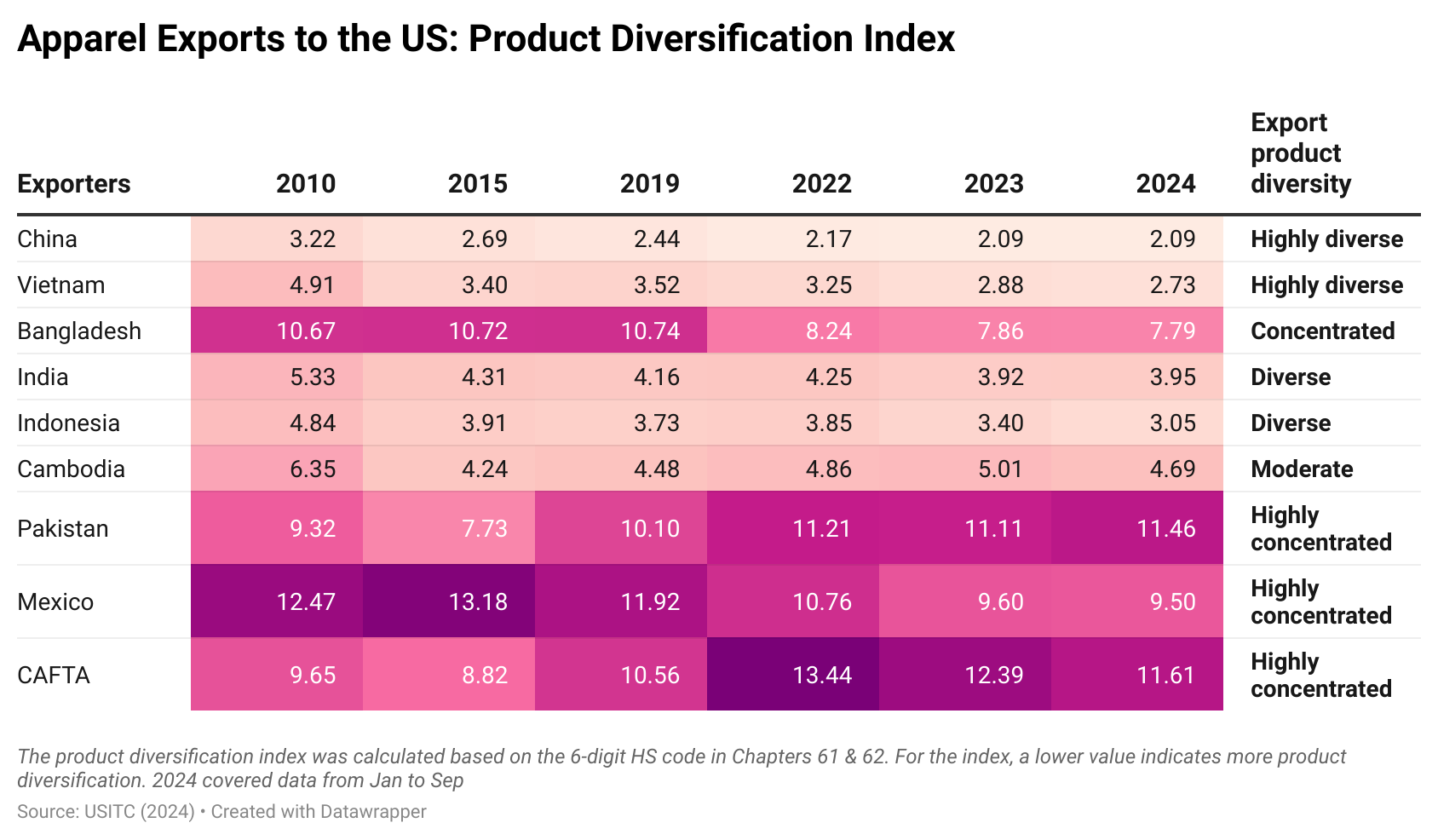
One major factor contributing to India’s perceived advantages in sourcing flexibility and agility is its ability to produce a wide range of apparel products. For example, the Herfindahl-Hirschman Index (HHI) calculated using trade data at the 6-digit HS code level indicates that US apparel imports from India cover more diverse product categories than most Asian countries. Likewise, by tracking US fashion companies’ websites, over 15K of Stock Keeping Units (SKUs) items labelled “Made in India” were newly introduced to the US retail market in the first 10 months of 2024. Although this number was smaller than China’s 60K offers, it far exceeded supplies from Cambodia (3.4K), Bangladesh (2.9K), Mexico (1.9K), and those in Central America and Africa (i.e., less than 1k of each country).
Moreover, due to India’s position as one of the world’s leading cotton producers, in the first 10 months of 2024, nearly 60% of US apparel imports from India contained cotton fibres, including 13% using organic cotton. This percentage was much higher than imports from other Asian suppliers such as China and Vietnam. In comparison, over the same period, US apparel imports from India appear less likely to contain man-made fibres like polyester, nylon, spandex, and recycled polyester. This fibre composition explains why India has yet to become a leading supplier of certain apparel product categories, like outerwear, which more commonly uses man-made fibre than cotton.
Additionally, in the first 10 months of 2024, over 45% of India’s apparel newly introduced to the US market targeted the luxury and premium segment, closely matching China’s nearly 50% and exceeding other Asian suppliers such as Vietnam (20%), Bangladesh (13%), Cambodia (5%), and Indonesia (18%). This result explains why US fashion companies increasingly consider India a strategic alternative to sourcing from China, given the similarities in their product offerings.
Conclusions and reflections
The study’s findings reveal India’s great potential to play a more significant role as a leading apparel supplier for US fashion companies. India’s large country size and population, the presence of an already highly integrated and sophisticated textile and apparel supply chain, and its ability to make a great variety of high-quality products suitable for various market segments position it well in the export competition. US fashion companies’ eagerness to reduce sourcing from China due to rising geopolitical concerns and the limited sourcing capacity elsewhere created historical opportunities for India to expand its apparel exports to the US market further.
Nevertheless, India’s prospect as a top-tier apparel sourcing base for US fashion companies is not without concerns. For example, it remains a question mark whether India is fully committed to expanding labour-intensive apparel production and exports, given the country’s economy is moving toward more capital and technology-intensive sectors. Notably, in value, apparel only accounted for about 5.6% of India’s total merchandise exports in 2022, similar to China’s 5.3% but much lower than other lesser-developed Asian countries, including Vietnam (10%), Bangladesh (88%), and Cambodia (44%).
Moreover, while India is not a primary focus for compliance issues like forced labour, sourcing from the country still carries general social and environmental compliance risks similar to those in most developing countries. It remains to be seen whether India’s textile and apparel mills are technically and financially prepared to meet more stringent social and environmental standards being adopted in the US and can effectively compete in the growing market for “sustainable apparel.”
About the authors
Gabriella Giolli is a researcher and teaching assistant at the University of Delaware. Dr Sheng Lu is a professor and director of graduate studies in Fashion and Apparel Studies at the University of Delaware.