
From USA-ITA OFF THE CUFF for August 31, 2012
On Tuesday, August 21st, SOURCING at MAGIC featured a seminar on sourcing in Southeast Asia, featuring a star panel of USA-ITA member companies including SGS, TigerTrade, Sandler, Travis & Rosenberg, and Jones New York.
The seminar was moderated by Katherine Stein, who manages international business development for softlines at SGS, a testing and certification company. She noted that there are 10 ASEAN member countries, and SGS provides factory certification in all of them.
The discussion kicked off with Tanjila Islam, CEO of TigerTrade, an online trusted partner network for global trade helping to support sourcing professionals connect to qualified manufacturers of apparel, textiles, footwear, furniture, and home décor in Southeast Asia. Islam explained that the ASEAN region is a viable alternative to China given the region’s diverse (and increasingly high-end) products, improved quality and production capabilities, and competitive pricing, to name a few. She then outlined pros and cons of some of the key ASEAN countries:
- Vietnam has a ready supply of labor, high production efficiency, and low costs, though there is a lack of skilled workers and the industry is dependent on imported fabrics.
- Indonesia has a large skilled labor pool and fully integrated supply chain that produces high-end basics, though it has aging equipment, high transportation costs, and generally poor infrastructure.
- Cambodia is another option for basics, with preferential access to the U.S., EU, Canada, and Japan, and the EU in particular makes many orders there.
- Thailand’s 1600 factories are fully integrated—though companies are increasingly moving to Myanmar.
- The Philippines has a shrinking industry, but does still manufacture for high-end brands.
- Myanmar is not yet open to the United States, but does produce a lot of Japan and Korea and we see great potential for future sourcing opportunities there.
While the pros and cons to individual countries vary, the ASEAN region as a whole boasts skilled workers, high efficiency, competitive labor rates, and an integrated supply chain—and is an excellent option if you are looking for alternatives to the rising labor costs and other issues in China.
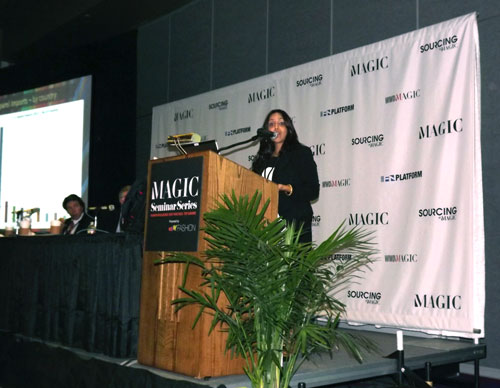
Tanjila Islam, CEO of TigerTrade, speaks at SOURCING at MAGIC.
Tom Travis, Managing Partner of Sandler, Travis & Rosenberg, spoke next about trade policy and how it affects your company’s bottom line. He noted that change is the only constant in trade—and if you look at countries like Cambodia, change can make a positive difference for the entire industry. He said he expects that the Trans-Pacific Partnership (TPP) will move forward eventually regardless of who wins the election, and said we should look for opportunities for exceptions to the expected yarn forward Rule of Origin in the agreement.
Finally, Joe McConnell, Vice President of Operations Initiatives & Integration for Jones New York, closed the discussion with the buyer’s perspective on Southeast Asia. Jones New York sees Southeast Asia as a viable non-China alternative, for many of the reasons Islam discussed such as attractive pricing, virtual vertical factories, and product availability. McConnell also noted that Southeast Asia is unique because smaller production lines allow niche brands to produce smaller orders.
McConnell gave some recommendations for companies looking to get into Southeast Asia. You must look for factories that have the following: a track record of quality, on-time deliveries; close fabric sources and supply chain partners; product development capabilities; and compliance with social and environmental regulations. Like other speakers, McConnell added that you can’t expect the same things you get from China, and you should have a blended sourcing strategy utilizing various regions.
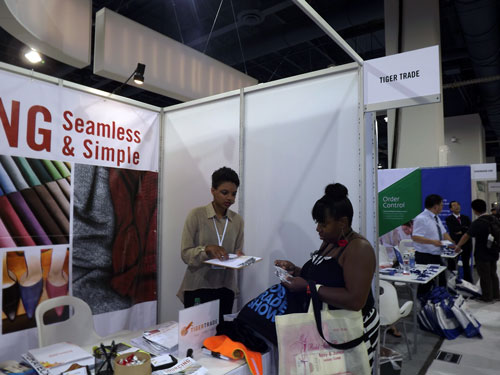
TigerTrade's booth in the SOURCING at MAGIC ASEAN Pavilion
A key takeaway from the Southeast Asia session was the idea that long-term partnerships are key. There are many opportunities in Southeast Asia, but brands and retailers should be willing to make a long-term investment in the region in order to get the most out of the relationship. And, if you do, you won’t be disappointed.