
From USA-ITA OFF THE CUFF for May 3, 2013
We know that corporate social responsibility is important to our members—after all, Levi Strauss & Co., one of our members, was the first company to adopt a human rights code in 1991, and has consistently set the standard for CSR programs in the apparel industry since. And, many other companies have followed suit. Yet, as CSR grows in importance, the need to stay on top of CSR grows in importance, too. On April 16th, USA-ITA and SGS hosted a half-day workshop on how to develop a CSR program within your company’s resources. Whether you’re just now testing the waters of CSR—or whether you want a refresher on the latest best practices in CSR programs—you’ll want to keep reading.

USA--ITA President Julia K. Hughes introduces the workshop and thanks our host, David Spooner and Squire Sanders.
Katherine Stein, International Business Development Manager for SGS, kicked off the meeting by noting that compliance is the “default” for our industry now. In other words, don’t even think about not being compliant because CSR is not just the latest fashion—it’s here to stay.
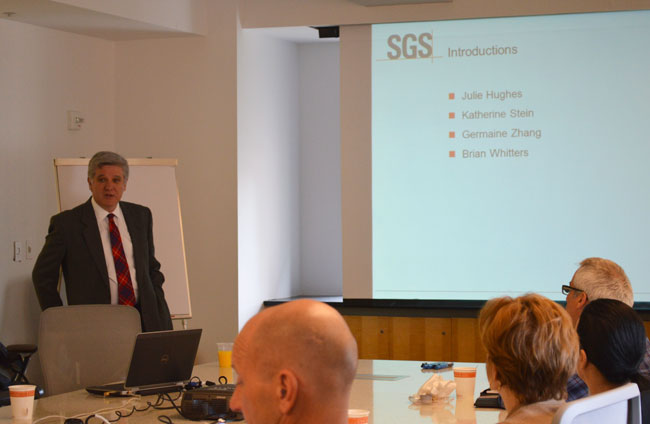
Brian Whitters of SGS explained how companies can develop a CSR program within their resources, no matter how large or small.
Brian Whitters, Deputy Vice President for Global Sustainability for SGS, began with an overview about corporate social responsibility. We hear the phrase “CSR” a lot, but what does it really mean and how can a company be a “socially responsible” one? Whitters explained that CSR is about self-regulation, and embracing responsibility for your company’s actions and encouraging a positive impact company-wide. In fact, your CSR program will only be successful if everyone in your company embraces that responsibility, starting with your executive leadership.
It’s important to have a CSR program in place—activist groups will undoubtedly be more interested in you when something goes wrong than when it goes right—but it also gives you a competitive advantage, because consumers are increasingly interested in labor and environmental issues, and importantly, buying from companies that are socially and environmentally responsible. (See page 14 of the presentation for more benefits of a CSR program.)
Whitters explained the elements of a CSR program, whether you’re starting at the beginning with developing a code of conduct, or whether you want to go beyond auditing and add environmental responsibility programs and root cause analysis. The workshop focused primarily on the elements of a basic approach, which includes the following steps:
$11. Obtain executive buy-in and assign accountability. It’s important to specifically assign CSR to someone, who will be held accountable, though it’s equally important for your entire company to be on board.
$12. Create a code of conduct. This code should show commitment, should be aligned to your industry and supply chain, and demonstrate both internal and external expectations.
$13. Map your supply chain, and assess the risks.
$14. Auditing and remediation. It’s important to remember that audits expire—and you don’t want to “certify” any factory, because the conditions inside that factory could easily change.
We encourage you to review the presentation, which goes into more detail in how to prepare for an audit and how to develop a supply chain roadmap, as well as covers new topics in CSR like the SEC’s conflict minerals rule. And if you have questions, whether you need assistance with developing a strong code of conduct, or something more in-depth, we encourage you to get in touch with SGS to talk about how they may help you.