
Despite the fact that the United States has numerous Free Trade Agreements and other preference programs in force, China remains the number one supplier of textiles and apparel to the country. Meanwhile, the United States continues to engage in negotiations for two of the biggest trade agreements ever—the Trans-Pacific Partnership (TPP) and the Transatlantic Trade & Investment Partnership (TTIP). During SOURCING at MAGIC in Las Vegas in February, we talked about how companies are—or more likely, are not—utilizing trade preference programs, and what we can expect from the ongoing negotiations.
United States Fashion Industry Association President Julia K. Hughes moderated a panel featuring three industry leaders: Steve DiBlasi, Vice President of Global Sourcing for Lanier Clothes; Stefanie Rotta, Senior Director of Global Sourcing Operations for URBN, which includes Urban Outfitters, Anthropologie, and Free People; and Juan Jose Del Real, Textiles & Apparel Executive Representative for Proexport Colombia.
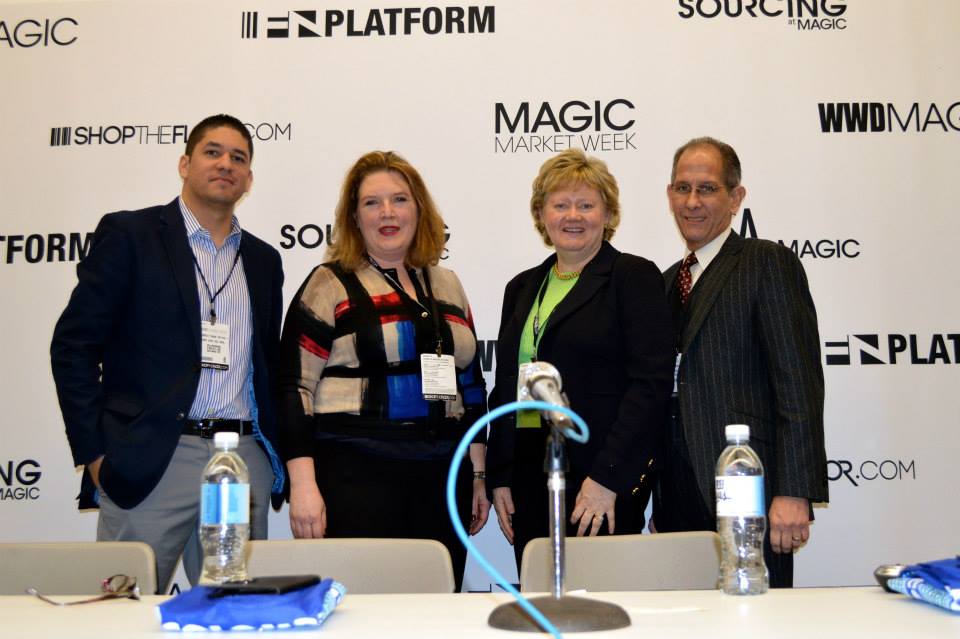
L to R: Juan Jose Del Real of Proexport Colombia, Stefanie Rotta of Urban Outfitters, Julia K. Hughes of USFIA, and Steve DiBlasi of Lanier Clothing.
Sourcing has always been complex, but these days, challenges continue to arise for fashion brands and retailers. Take a company like Lanier Clothing, which specializes in men’s tailored clothing. In this jeans-and-tees world, the market for tailored clothing is declining, says DiBlasi, so it needs to be especially cost competitive for consumers to purchase it. In fact, consumers want to pay as little as possible for clothing, which presents challenges as costs continue to rise all over the world. (See our coverage of the ethical sourcing panel for more about these challenges.)
It seems like FTAs would be the answer, but that’s not true for many fashion brands and retailers. According to U.S. Customs and Border Protection, only 14 percent of apparel imports come into the country duty free. What’s the issue?
For one thing, says DiBlasi, price is not the only determining factor. Fashion brands and retailers must consider a myriad of factors, including quality, speed to market, ease of sourcing with vertical operations, freight costs and times, and the need for a mature, skilled industry. When you consider all these factors, it’s often not more cost effective to source from a free trade partner than to continue sourcing in China or Vietnam. If you’re going to dive into FTAs and preference programs, DiBlasi says you need to learn the agreements, calculate the landed cost, and then see if it will fit in your business and sourcing model.
Rotta explained that URBN, a multi-brand lifestyle retailer that is just now expanding into Asia, faces similar issues when trying to utilize FTAs. For a company like URBN, which has some brands with higher price points and a global, eclectic feel, flexibility is critical to the sourcing strategy, along with relationships with your suppliers. Despite the fact that the TPP is not yet finished, URBN already sources from Vietnam and has developed strong relationships with quality suppliers there—and while they would love to source those products duty free, cost is obviously not the reason why they source there.
So, what’s happening with TPP, anyway? “TPP is not the shining star we had all hoped for, but it’s still a good opportunity in Vietnam,” said DiBlasi. All the speakers agreed that the TPP could provide an opportunity for fashion brands and retailers if the rules are flexible enough, but right now, the yarn-forward rule of origin and other restrictions we expect to be included will make it difficult for fashion brands and retailers to utilize it. The speakers agreed that they would love to see a generous short supply list and reconsideration of the yarn-forward rule—but we’ve got a long way to go.
Likewise, TTIP could also provide an opportunity, especially on regulatory issues. If the United States and European Union are able to harmonize regulations, such as labeling, testing, and compliance, the rest of the world could follow their lead and we could eliminate another barrier to the movement of fashion products across borders. However, given the political climate in both the U.S. and EU, we’re unlikely to see an agreement anytime soon.
One option for fashion brands and retailers exists close to home, though. Real explained that Colombia is a relatively new duty-free opportunity, as the permanent FTA went into effect just last year. Colombia provides knowledge many things that these brands and retailers need: flexibility, vertical production, knowledge of the U.S. market, and of course, rapid speed to market due to the location in the same hemisphere.
For more photos, visit our Facebook page!
And stay tuned for coverage of the SOURCING at MAGIC seminar on intellectual property protection in China, featuring experts from Squire Sanders, in the next issue!