
As you know, we’ve partnered with Euromonitor International, a world leader in strategy research for consumer markets, to bring unique insights and analysis on the industry. This month, Apparel & Footwear Research Associate Bernadette Kissane takes a look at the growth of menswear—and how for the second consecutive year, it’s actually outpacing the growth of womenswear.
Global Apparel: It’s a Man’s World
Menswear is growing faster than womenswear. For the cynics dismissing this as a statistical anomaly, the pattern is emerging as clearly as a perfectly tailored bespoke suit. In 2014, for the second consecutive year, growth in men’s clothing surpassed that of women’s, with 5 percent and 4 percent growth in current value terms respectively. Although menswear only accounts for 25 percent of total global apparel sales, the category is expected to continue outperforming womenswear with an annual value sales increase of US $40 billion from 2014 to 2019. This growth is being driven by cultural shifts as men become more concerned with their appearance. This is coupled with large disposable income levels for men, which remain 50 percent higher in comparison to women’s disposable income levels. As the four main fashion capitals, New York, London, Paris, and Milan, prepare for upcoming Men’s Fashion Weeks, brands need to consider how best to cater to this increasingly lucrative consumer group.
Liberal Attitudes
A big sales leap in emerging countries saw China overtake the United States in sales in 2014, gaining the largest menswear retail value sales worldwide at US $85 billion. Furthermore, India experienced 14 percent growth in men’s clothing compared to 11 percent for women’s clothing in the year. Similarly, men’s grooming products are experiencing a significant sales boost in emerging countries. For example, in India, male skin care saw a value CAGR of 20 percent over 2009-2014. This illustrates the emergence of a more open-minded mid-income male consumer base, with these consumers being highly conscious of their appearance, providing the apparel industry with a huge opportunity.
Big Spenders
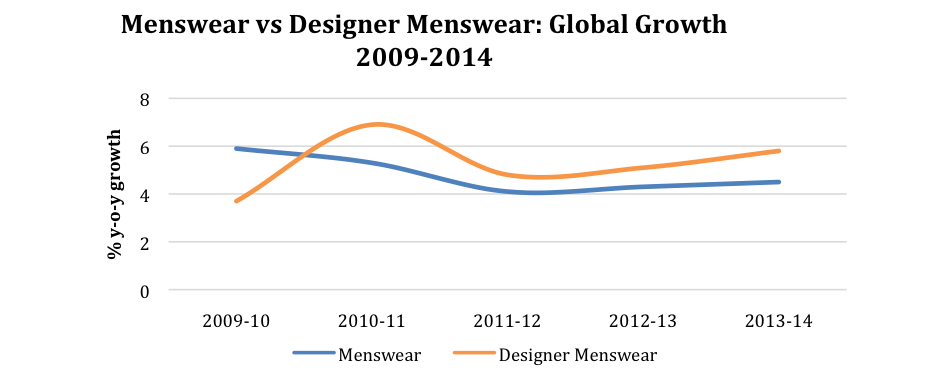
According to Euromonitor International data, growth in men’s designer apparel and footwear is surpassing growth in overall menswear, as men are more inclined to pay higher prices for branded products that they know and trust. Moreover, men are less frequent buyers than women, instead choosing to focus on quality and style over disposable fashion. The increasing demand for luxury products has also begun to infiltrate sportswear, with retailer Mr. Porter notably introducing a sport section focusing on technically advanced and performance-led clothing.
To address men’s preference for premium products, leading fashion houses such as Burberry, Alexander McQueen and Hermes launched men-only stores in the last few years. Furthermore, J. Crew entered the United Kingdom with a men’s store, thus highlighting the potential for growth in this country. Meanwhile, department stores are refurbishing and relocating their menswear departments, moving these to more prominent locations. Traditionally, women were the core purchaser of men’s clothing. This, however, is changing, as men begin to enjoy shopping for themselves and becoming more creative with their everyday wardrobes. As a result, those who choose to invest in creating retail spaces dedicated solely to men, while providing a comfortable and engaging store experience, will be best equipped to capitalize on this expanding product area.
Mars and Venus
It is telling that "lads' mags" are now evolving into lifestyle magazines that men use as educational tools for the latest health, fashion, and beauty trends. A growing number of blogs and menswear internet retailing players are meanwhile providing a wealth of information on styles and brands, informing men about how and what to wear. A new generation of fashion-conscious millennials are thus finding the confidence to experiment with their personal style. However, this increasing interest in fashion does not necessarily mean that brands should target male consumers in similar ways to women. Instead a curated edit of items, a seamless transactional process and an indirect approach to marketing will go a long way in appealing to this target consumer base.
Established in 1972, Euromonitor International is the world leader in strategy research for consumer markets. Comprehensive international coverage and leading edge innovation make Euromonitor's products an essential resource for companies large and small, national and global.
As an independent company, Euromonitor offers unmatched detail and unbiased content for every region, country, category and channel. From socioeconomic context to intimate detail on the smallest products or markets, Euromonitorprovides market research and surveys focused on your organization’s needs.
For more information, visit our website or contact Chourouk Gorrab, Communications Executive at Euromonitor International, at +44 (0)20 7251 8024 EXT 1357 or