
From USA-ITA OFF THE CUFF for March 1, 2013
From February 18th through 21st, USA-ITA again participated in SOURCING at MAGIC, the largest textile, apparel, accessories, and footwear trade show in the United States. In addition to hosting a booth in the Sourcing Resources Center, we attended a number of seminars on sourcing opportunities and challenges and sourcing in the Western Hemisphere, as well as our own seminar, which featured Gail Strickler, Assistant U.S. Trade Representative for Textiles and Apparel. Click the links below to jump to full recaps of these seminars, or visit our Facebook page for more photos!
- Obama’s Second Term: Focus on Trade & Apparel
- Sourcing Opportunities & Challenges
- The Americas: Sourcing Opportunities in Our Hemisphere
Obama’s Second Term: Focus on Trade & Apparel
On Wednesday, February 20th, USA-ITA President Julia K. Hughes moderated a seminar on what we can expect from trade during the Obama Administration’s second term. The panel featured a presentation from Gail Strickler, Assistant U.S. Trade Representative for Textiles, as well as commentary from Hughes and Mark Jaeger, Senior Vice President, General Counsel, & Secretary for Jockey International.
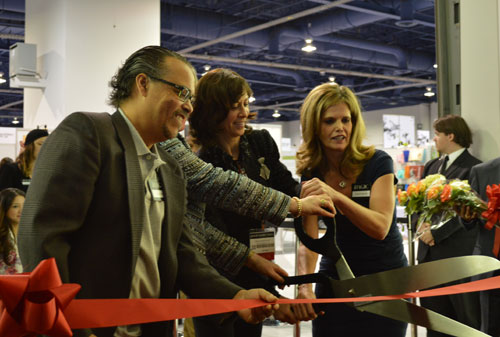
USTR's Gail Strickler cuts the ribbon at the Sourcing Hall.
Strickler started with an overview of the Obama Administration’s trade agenda for the next four years, including the Trans-Pacific Partnership (TPP) negotiations, which were covered extensively later on in the presentation, and other ongoing negotiations. President Obama announced the launch of the U.S.-EU Trans-Atlantic Partnership negotiations during his recent State of the Union with an aggressive 18-month deadline to complete the agreement. Mark Jaeger said that this this announcement was exciting to trade, as it marked a commitment by the Administration to opening markets, though Rule of Origin will be an issue in the negotiations just like it is in the TPP negotiations.
Another priority for the Administration is enforcement. By enforcement, Strickler means addressing counterfeits and other threats to both U.S. exporters and U.S. importers—and the Office of the U.S. Trade Representative has shown a commitment to this ideal with its recent action on Argentina’s “trade balancing” provisions. Strickler urged attendees to let USTR know if you see any problems that require action.
After a recap of the Administration’s trade activities over the past four years—from the passage of the Korea, Colombia, and Panama FTAs to the implementation of the CAFTA-DR fixes to the extension of the African Growth & Opportunity Act Third-Country Fabric Provision—Hughes asked Jaeger how he would grade the Administration on trade. While he is encouraged by the Administration’s recent actions on trade, he said that the real grade will be given with the results of the TPP negotiations and the U.S.-EU TAP negotiations, as well as the results of enforcement efforts.
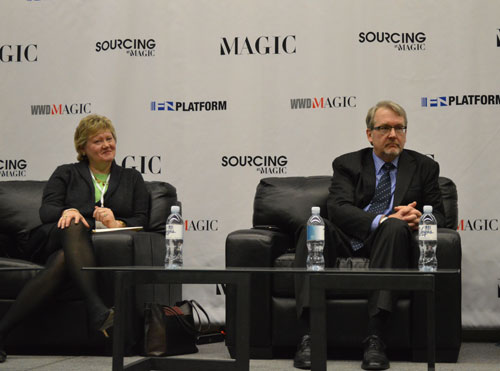
Julia K. Hughes and Mark Jaeger during SOURCING at MAGIC
The conversation then turned, of course, to the Rule of Origin discussions for apparel in the TPP negotiations. Strickler said that while the quality of the agreement is important, the Administration is ready to just get it moving. She explained the new short supply process and noted that they will be discussing the first round of requests during the negotiations in Singapore in March. Of particular note to the SOURCING at MAGIC audience, Strickler explained that there are four types of items that can be on the list—entire HTS classifications, subsets of HTS classifications, products with a specified end use, and composite products with a specified end use—and that this process does not just apply to retailers and importers, but also to U.S. manufacturers and knitters who may be importing components. She urged companies to make their requests “as broad as possible but as narrow as they need to be.” (More details on this process can be found on our website here.) Hughes noted that USA-ITA is actively involved in this process and helping companies craft requests that are broad enough to be a “two-way street” but will also not harm U.S. manufacturers.
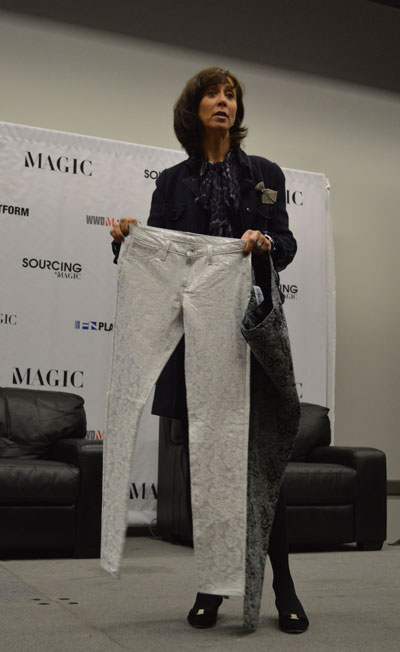
Gail Strickler explains what types of products might work for the TPP short-supply list.
Jaeger said that this is an original and creative attempt, but ultimately, the agreement will need to be meaningful for the Vietnamese. The U.S. may be hesitant to give them everything they want—but we need to remember that they are hesitant to give us access to some of our most important exports, like cars, dairy, and pork. Strickler added that it’s also important to boost emerging markets for our own sake, because we need people to buy our exports, too. Ultimately, the agreement must be a 21st-century, high-standard agreement that has some benefits for everyone.
Click here to download Gail Strickler's presentation.
Sourcing Opportunities & Challenges
As the many seminars on sourcing explained, sourcing is complicated! To manage it, you must 1. Define your needs and values, and 2. Find partners who can meet your needs and share your values. If you do these two things, you’ll have a clear path to making sourcing decisions.
On Tuesday, February 19th, we attended a seminar titled “Sourcing Outlook for 2013.” Moderated by Katherine Stein, Director of International Business Development at USA-ITA Associate Member SGS, the panel provided an overview of opportunities and challenges in the sourcing realm for the coming year and beyond.
Ken Mangone, former Executive Vice President of Product Development, Design, and Sourcing for J.C. Penney, and former USA-ITA Board member, kicked off the discussion by outlining the numerous issues sourcing executives must consider: sustainability, compliance, rising labor costs, inflation, speed to market, an increase in environmental regulations, factory consolidations, and raw material volatility, to name a few. How can sourcing executives manage these issues?
- Accept that the landscape has changed. You should be open to these changes, and specifically, emerging suppliers and countries, such as the Western Hemisphere and even the United States.
- Choose the right partners—and specifically, partners who can move your strategies forward and share your values. This is especially important if you value sustainability highly, as sustainability requires the entire supply chain to put sustainability first—but this is not always the cheapest option, of course.
- Develop a “sourcing toolbox” with a variety of sourcing options to manage your priorities, such as cost, speed, flexibility, or all of the above. Before you make any sourcing decisions, you should rank these priorities, and then determine what ratio of risk to reward works for you and your partners. This toolbox is like a rubix cube—and there’s never one right answer.

Ken Mangone speaks during SOURCING at MAGIC.
Mangone was followed by Courtney O’Keefe, Senior Vice President of Product Development & Sales for Norwest USA. O’Keefe echoed Mangone’s outlines, noting that you should take a “multi-prong approach” to your sourcing while finding partners who are complementary, not competitive. There are many options—Norwest alone sources in Bangladesh, China, Sri Lanka, India, and Turkey, to name a few—but you should go where your needs can be met. The discussion closed with insights from Crystal Button, Vice President of Global Sourcing/Tech Design for OSP (formerly Redcats USA).
Later Tuesday afternoon, we looked at sourcing from the perspective of contemporary fashion labels. Moderated by Barbara Ende of Sycamore Marketing Group, the panel featured insights on sourcing from AllSaints Spitalfields, Eileen Fisher, Suno NY, and Edun, companies that are committed to sourcing in a sustainable, ethical, and innovative way. How do they do this? The key is recognition—recognizing your own values, recognizing when you have a good partner (and sharing that information!), and recognizing your impact on your sourcing partners.
Deborah Keiser, Global Supply Chain Director for AllSaints Spitalfields, kicked off with a powerful presentation about the company’s commitment to protecting workers and the environment while sourcing, and why other companies should do the same. “Sourcing is a political act,” she said, explaining that where and how we source has profound impact on people’s lives. AllSaints sources from numerous developing countries, and participates in organizations that give back to these countries, such as Pathfinder International, Not For Sale, and Nexgen Packaging, to name a few. Keiser echoed the previous panel, noting that you must establish your company’s values first and then find a network of partners who share these values.
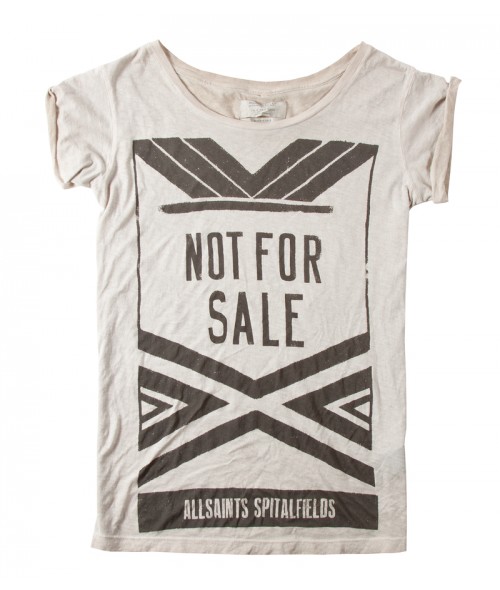
AllSaints Spitalfields sells these shirts to benefit Not For Sale, which fights to end trafficking and slavery.
Shona Quinn, Sustainability Leader at Eileen Fisher, agreed. Eileen Fisher has shifted its sourcing perspective to recognize the impact of its sourcing decisions on the earth. This is especially important as consumers are becoming more aware of these issues (“citizen consumers,” she calls them) and want to buy from companies that take the environment into account. As just one example, Eileen Fisher has started a new program called Green Eileen, in which stores sell used Eileen Fisher clothing to raise money for charities for women and girls, which has the dual effect of reducing textile waste as well as giving back to sourcing partners.
Nadiyah Bradshaw, Head of Sourcing & Production for Suno NY, spoke next about the company’s incredible initiatives in its sourcing partner countries, which range from Kenya, to New York City, to Peru. Bradshaw had two important points for sourcing executives. First, we talk about finding partners for ourselves, but we also must be partners to them, as they are taking a risk, too. And to do that, you must understand the culture from which you’re sourcing so you can build mutual trust.

Suno NY Resort 2013 (Via Style.com)
Finally, Melanie Reichler, Vice President of Product Manufacturing & Sourcing for Edun, closed the panel by talking about Edun’s history and goals. She noted that it’s important to remember that you can make a difference with your sourcing choices, so pick a few countries, and grow there. And importantly, don’t leave if you have a few problems—instead, give those factories more work, and help them, and you’ll make an even bigger difference.
The Americas: Sourcing Opportunities in Our Hemisphere
Tuesday afternoon closed with a session on sourcing in the Western Hemisphere. As speed-to-market becomes increasingly important in our industry, brands and retailers are looking “closer to home,” to the numerous opportunities in the Western Hemisphere.
Walter Wilhelm of Walter Wilhelm Associates LLC moderated the panel, starting with a relevant quote by Sir Phillip Greene: “They want steak, cheap—not cheap steak.” And companies can get steak, cheap (or cheaper, at least), from neighbors like Mexico, Colombia, Peru, and the CAFTA-DR region.
Apparel brands and retailers spoke about their experiences—both positive and negative—in the Western Hemisphere. Barbara Nicholson, Vice President of Operations for Brooks Apparel/Moving Comfort, noted that with labor shortages in Asia, price is going up—but quality is not. Brooks Apparel has looked to Central America, the United States, and Mexico (as well as Sri Lanka) and found stability, quality, and easy replenishment for popular products. Alfredo Frech, Vice President of Business Development and Marketing for Industrias Merlet, sources knits from El Salvador and Guatemala, and has a design shop in Miami, and says that this hemisphere provides vertical integration with opportunities for easy replenishment programs and sustainability programs. While there are some challenges—such as difficulty finding some fabrics that are easily found in Asia—investment in the region is increasing. Finally, Anthony Travis, Sourcing Manager for Perry Ellis International, agreed that while price and fabric can be issues, the region also provides quick turnaround and high quality products.
We also heard from Carlos Arias, CEO of Kaltex Apparel, the largest vertical apparel company in Mexico. He agreed with the pros and cons the speakers mentioned, but added that you can’t use Asia models in the Western Hemisphere.
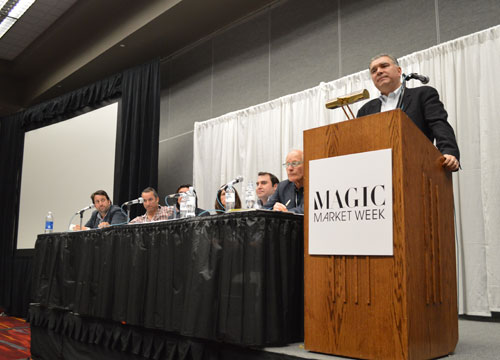
Carlos Arias speaks during SOURCING at MAGIC.
Other speakers included Simon Cohen, President of 291 Venice, who sources 95 percent of his apparel from Los Angeles, and Don Young, CEO of Merchant Coterie, which provides back-end sourcing solutions to brands and does increasingly more business in the Western Hemisphere.
The takeaway from the session was that there are many pros and cons to sourcing in the Western Hemisphere. However, if you follow the advice of the previous sessions by first determining your priorities and values, and have an open mind, you can likely fit the Western Hemisphere into your sourcing toolbox.