
Rising costs. Increasing competition. Mushrooming regulatory requirements, as well as navigating global risks to guarantee corporate social responsibility. It sounds gloomy, but the atmosphere was anything but during SOURCING at MAGIC last month in sunny Las Vegas. USFIA was on the scene as our members and friends talked about how to address these challenges while producing the fashion that consumers want.
As regular readers know, SOURCING at MAGIC is the largest, most comprehensive sourcing event in North America. Offering unmatched access to over 40 countries representing the world’s most important markets, the event showcases more than 800 apparel, accessories and footwear resources, merchandised by country and category. Once again, USFIA had an information pod at the front of the half-mile-long (so we heard!) show floor and got a chance to catch up with many of our members who were exhibiting, including Proexport Colombia, the Ready-Made Garments Export Council of Egypt, the Taiwan Textile Federation, SGS, and Worldwide Responsible Accredited Production (WRAP).
But the highlight of the show is the seminar series—and not just because we get to sit down and rest our feet for a few hours. In August, several seminars covered the myriad of challenges that companies face today—costs, competition, and compliance, to name the three big ones—and how to address them. And across all seminars, one message was clear: balance is critical.
On opening day, USFIA President Julia K. Hughes moderated a seminar titled, “Looking Forward: From the Western Hemisphere to Africa: Pros & Cons.” Longtime sourcing executives Bill McRaith of PVH and Steve DiBlasi of Lanier Clothes joined Tom Travis of Sandler, Travis & Rosenberg to discuss sourcing challenges and solutions. The key takeaway was that when you have many challenges to juggle, the solution is to take a global, balanced approach to your supply chain.

USFIA President Julia Hughes leads a seminar with PVH, Lanier Clothes, Sandler Travis & Rosenberg, and the East Africa Trade Hub at SOURCING at MAGIC in August 2014. (Credit: USFIA)
Hughes kicked off with some sourcing trends, noting that China remains the dominant supplier, although Vietnam is up to the challenge and companies continue to look for opportunities closer to home, too. (You can download her presentation by clicking here.)
As the sourcing executives would explain, all of these opportunities are important in a balanced supply chain, though they all take different approaches to achieving that balance.
McRaith said that in order to meet consumers’ desire for the right product at the right price, a balanced supply chain isn’t just important but absolutely critical. He’s a big supporter of Africa and utilizing the African Growth & Opportunity Act (AGOA), which provides duty-free access for apparel cut and sewn in eligible countries, and he urged companies to take a look at Africa due to the abundance of low-cost labor, green energy, land, and of course, the duty savings in the United States and European Union. Not to mention, manufacturing in Africa is a win-win for both U.S. companies, who will see advantages for their balanced supply chain, and for Africa, which will benefit greatly from the jobs and development. McRaith also touted the benefits of sourcing in the United States, noting in another seminar hosted by SGS that after a 15-year break, PVH is now sourcing in the United States again. But he does not see Africa and the United States as competitive, but complimentary in a balanced supply chain.
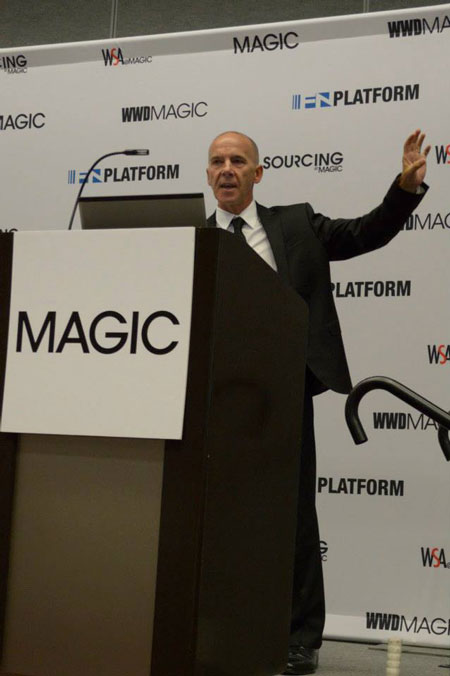
Bill McRaith of PVH at SOURCING at MAGIC in August 2014 (Credit: USFIA)
DiBlasi also touted the need for balance—though he urged companies not to get sucked into “the next great sourcing opportunity” without carefully looking at the product, the price, the quantity needed, and most of all, the risk for your company and supply chain. A good way to deal with challenges, particularly related to saving time and money, he said, is to look for vertical operations, such as using Peruvian fabric to make cotton trousers in a factory in Peru, as just one example. If you’re producing small quantities, he agrees that sourcing close to home is the way to go, as you can save money and time when shipping and have a quick turnaround. But if you’re producing larger quantities, you can definitely look all over the world because you have the ability to negotiate price. Overall, he said, the key is to determine if you need quick turns, low costs, or both, and then take a balanced approach to fill your needs.
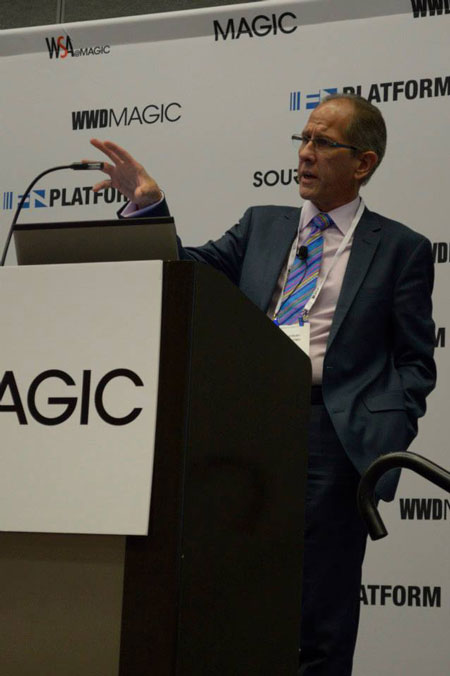
Steve DiBlasi of Lanier Clothes at SOURCING at MAGIC in August 2014 (Credit: USFIA)
Tom Travis concluded the seminar by noting that, although companies aren’t utilizing free trade agreements and preference programs as much as they could, they should. “Trade agreements win,” he said. If you can make them work for you, you can beat your competitors. It’s important to note that “FTAs are not free” because they are often quite restrictive, but if you learn the rules then you’ll have many more sourcing opportunities available to you to help balance your supply chain.

Tom Travis at SOURCING at MAGIC in August 2014 (Credit: USFIA)
While there are a multitude of options for sourcing, the one area in which you don’t have an option is compliance, DiBlasi noted, and other speakers throughout the seminar series agreed. During the SGS-sponsored seminar, Clay Hickson of Worldwide Responsible Accredited Production (WRAP) says the dilemma with sourcing today is not finding product, but finding product as consumers demand lower prices while costs continue to rise. But social compliance is equally important for your brand—and for many consumers—as price. While product compliance has always been important, it is increasingly the responsibility of the brand or retailer to take responsibility for the employees and building, too.
As the fashion industry continues to globalize, there are limitless sourcing opportunities for brands and retailers to choose—many of which were on display in Las Vegas. By taking a balanced approach with an eye to compliance, brands and retailers can ensure success.
For more photos from SOURCING at MAGIC, visit our Facebook page!